Friday, March 23, 2018

Claw #1


Fantasy February and Magical March!
Claw #1


DC goes all Fantasy on us!

"The Sword and the Silent Scream”
Written – David Michelinie
Artist – Ernie Chan
Editor – Joe Orlando
May-June 1975

The time was 1975 and DC began trying something new to boost sales. Deciding Marvel’s success with its Conan fantasy title was the way to go, DC started the prior year with mixing in various sword and sorcery tales/fantasy tales in with its stable of super heroes. They christened it the “Adventure Line” and out of the seven titles debuting over the course of 1974-1976, all but one could be in some way considered fantasy. That exception would be the adaptation of The Avenger series of paperbacks into the series Justice, Inc.


Along the fantasy spectrum the list included a reintroduction of the prehistoric cavemen Tor (from 1954) and a new prehistoric character named Kong, the Untamed


In the Conan mold we had Stalker, the man with the stolen soul created by Paul Levitz and Steve Ditko, Beowulf, Dragon Slayer by Michael Uslan and Ricardo Villamonte, Warlord by Mike Grell and the fella we’re here to discuss today, Claw.

It’s important to note that all of these with the exception of Warlord were cancelled within a year, most lasting all of six issues. Claw got double that chance, being closest in look and attitude to Conan adding to the character’s longevity. The book was a victim of the DC Implosion of 1978, and its cancellation was a surprise to all involved. Two issues had already been written and drawn at the time of cancellation, and these stories were published in Cancelled Comic Cavalcade #1 in 1978. 

So much for trying to broaden your spectrum of books DC.

This book was Claw’s first appearance and serves as origin story, character introduction and adventure all rolled up into one. We’ve got David Michelinie as creator and writer plus Ernie Chan doing all the art chores. If that sounds like it might be up your alleyway, then read on as we dive right in…

We find our hero Valcan striding without a care through the streets of the city of Ichar. He’s eyed by the ladies for his bulging loincloth and by thieves for his bulging gold pouch. Valcan is a strictly “look but don’t touch” sort of guy though.


This guy they call…


Forget that they misspell Ernie’s last name here and just check out that door-busting scene. If you’re picking up a Conan vibe you aren’t the only one.

Why is he called “Claw,” you may ask? It isn’t because he had that “one glove” idea centuries before Michael Jackson. Let’s give the reader a hand so they can tell where he gets his nickname.


Yep, and as was later tied-in via a backstory in Warlord, there was a demon out there with Valcan’s human hand on his arm. I didn’t get all the parts of that tale so I can't relate why that is.

Note one important thing about Valcan: he isn’t necessarily the hero here. He’s brash and boastful as well as insulting. There was very much a Conan vibe that Michelinie was trying for.

Now we get into adventure mode, the girl tells her pimp (okay, maybe not the exact term, but close enough) and he pays some guys to bust Valcan up on the way back to his digs.


Of course, Valcan slices through them like a hot knife through butter…or maybe more like a demon-hand wielded broadsword through viscera. 


And he gets to the “master” and makes a very non-hero type statement. The villainous innkeeper is saved by the arrival of the city guard and Valcan deciding he didn’t want the entire police force on him for slaying men of the watch. As our main character beats feet, we turn to the innkeeper informing the ruler of the city of the man with the demon hand. Appears this Occulas of the Yellow Eye has been looking for Valcan for some time without success.


And just to prove his intentions aren’t good, he kills the innkeeper so he won’t snitch to Valcan. Then he chats it up with his wizard Miftung and his swordsman Zedon, both of whom I bet will make mischief for Valcan.


But before we throw anymore guys onto the point of Valcan’s sword, let’s take a look back at Occulas’s past to determine why he wants Valcan so bad. For that we go back to the days when he was not yet ruler of the kingdom and learn that he was an ungrateful little shit who decided to kill his father and make himself king. The court wizard saw he would be victorious, but that justice for the deed would come from a hand webbed like a dragon’s paw.


So the prince tortures a buuunch of people until he finds just such a guy with a demon-webbed hand and then sends his guards to kill him. The owner of said hand, a local woodsman, is an amicable sort who would have gone along with the guard dispatched to bring him in for questioning. Would have, except he is killed by the guard under orders  that he not make it to the castle alive.


But what the guard did not notice in slaying both Kegar and his wife was that they had a child who also bore the demon-hand deformity. And that child is taken in by some mysterious, magical, and ghostly benefactor.
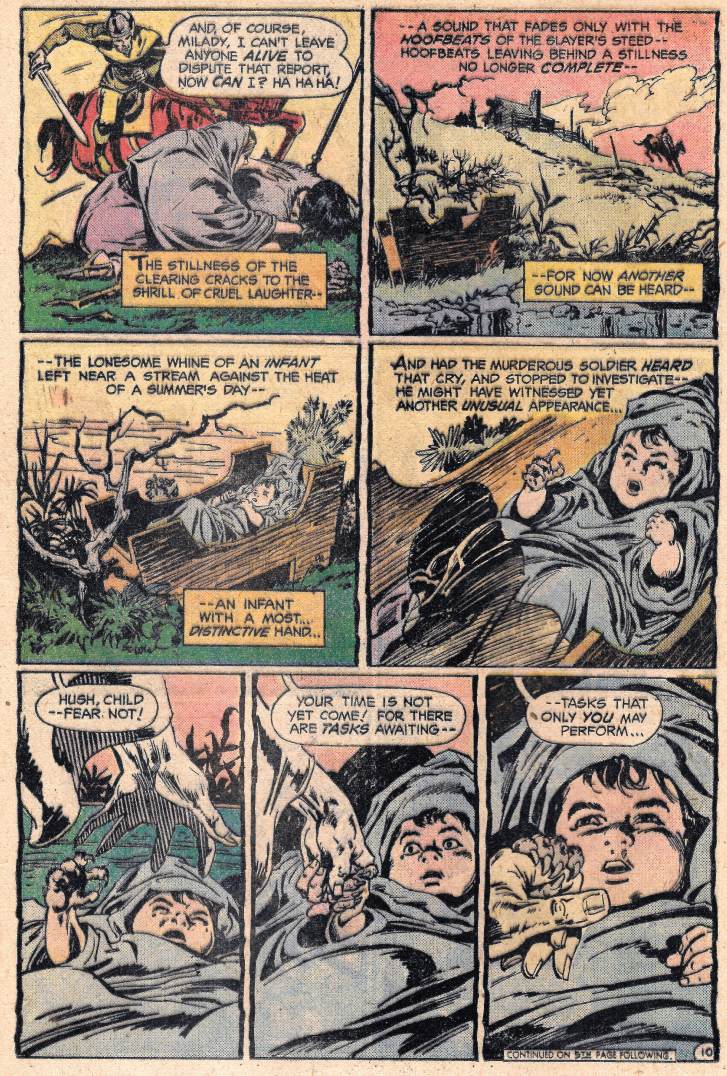


Thus thinking himself safe, Occulas kills his father using poison and takes his place. He’s a horrible ruler, of course, and has troubled dreams every night of the man with the clawed hand coming for his life. 


So what’s a ruthless, vile ruler to do? For starters, how about having your court wizard hand off this giant magical crystal to your chief swordsman. Especially since the gem might be super dangerous to the person using it and that Zedon guy has been getting a might uppity.


While all that is going on, the pimp-less serving girl now decides to lead Valcan away from the pursuing guardsmen to safety. What kind of safety that will turn out to be, one can only imagine.


As the girl (nameless character, will possibly die by issue’s end) thanks Valcan for indirectly ridding her of her boss, she leads him to an abandoned temple to get him out of the guard’s crosshairs. On the way there, Valcan does his best pickup line which happens to be "I think I’m so great that my efforts at hacking people up with a sword will shape the future for everyone on this planet." With that, the pair arrive at the temple of…


KAAAAAAAAAAAAAAANNNNNNNNNNNNNNNN! 


(Come’on. Somebody had to.)

Just about then Zedon arrives, threatens Claw and puts the jewel on the altar. Badda-bing, badda-boom!...


Giant evil Lovecraftian nightmare appears and starts screeching and tentacle raping everyone. Valcan isn’t having any of that action though and saves the girl, to boot.


And while Valcan’s sword betrays him, the warrior finds that a sharp stick in the right place can kill an evil elder god. 


As and added bonus, Zedon has been turned into a rotting corpse and Look! A Free Sword! The brunette makes a play to hang around Valcan (although why? Is kind of a mystery. Any guy that causes giant monsters to attack you the first day you meet him kinda seems like trouble to me.) And while Valcan says he prefers horse (or something, I might have checked out around here), he still takes her along. 


But at the next oasis, she proves to be a turncoat again. So Valcan leaves her for the jackals and continues on his merry way alone, off to find his destiny.


Alright, so this was pretty good. I knew Michelinie from his Spider-Man days and this proves he had the chops for a good tale even earlier in his writing career. A few of these have popped up in the Crapbox, so maybe you haven’t seen the last of Claw in my reviews. I certainly hope to have time to visit him again soon.  

Wednesday, March 21, 2018

Hercules #10


Fantasy February and Magical March!
Hercules #10


Taking on Hydra way before that Nick Fury chap

"The Ninth Head that Couldn’t Die”
Writer – Joe Gill
Penciller – Sam Glanzman
Inker – Sam Glanzman
Colorist - unknown
Letterer – unknown
Editor– unknown
1978 originally presented in 1968

Hercules is too good a character not to have in your comics' universe.

The Marvel Universe has been lousy with Hercules appearances over the decades. From his time as an Avenger to his time founding the LA group the Champions to his recent solo series the Incredible Hercules, the character has popped up hundreds of times in Marvel books for something like 1600 appearances (according to Comics Vine).

DC had a Hercules too. He appeared in an early Wonder Woman book, where Queen Hippolyta schooled Wonder Woman in how to attract a man by telling the tale of how she got floozied it up to get the attention of a certain demi-god. This was all way back in 1962, but by 1985 George Perez saw the Hercules (now Heracles) thing a bit differently. He went about painting him as kind of a thief and possible rapist. Which totally destroys all the goodwill that the DC Hercules earned in his 12 issue Hercules Unbound book from Gerry Conway and Jose Luis Garcia-Lopez somewhere between those two appearances.

The we get him showing up in Savage Dragon, TV tie-ins to the Kevin Sorbo Hercules: The Legendary Journeys show, pop-ins to Grimm Fairy Tales, Child of the Sun, Holy F*cked, Kingdom Hearts, Michael Chiklis Pantheon (that’s a real book?), Capes, The Godyssey, Wrath of the Titans, The Mighty Hercules (from the cartoon), and this little slice of heaven from Modern/Charlton Comics.

Released originally in April 1969 under the Charlton label for a price of fifteen cents, the book was re-released under the Modern Comics imprint with a price of thirty-five. The Modern label marks it as something that would have been released in the 1980’s and sold in three-for packs at department stores, but the copyright marks on the title page state the book was made in 1978. I’ll let Charlton Hero come in here and lay history out on books like these at some point. I know enough to state the stories in the earlier book and this one are identical, right down to the cover art. Using tactics such as this, Charlton was able to eke out a few more years until their presses deteriorated and they were bought by DC.

For now let’s put aside how this little number came to be and focus on what did make it into our hot little hands. We begin with Hercules standing amid two demons while wreathed in flames, the pelt of the Numidian Lion Rob Liefielding his feet. He is waiting some word from his father Zeus because he’s been doing this “12 Labors” thing for 9 or so Labors and he’s a bit tired. 


Now before you all start in on me, yeah this goes against the classic 12 Labor storytelling a bit. In the Greek Myth, these were accomplished over 12 years. Originally it was recorded as an epic poem, now lost, written by Peisander around 600 BC. In myth it started after Hercules sought forgiveness for killing his wife and children from the oracle at Delphi. He was told to serve the king of Mycenae, whose name was Eurystheus, for 12 years. Here the book speeds up things and has Herc forced to do the labors one right after the other.

The ordering is a bit screwy too. Typically the Lernaean Hydra comes around labor number two. Here we have it placed as labor number ten.

But on to what the book says, as Hercules begs for some time off, but Zeus isn’t on the other end of the cosmic phone line. Nuh-uh. Tis Hera, Zeus’s wife, who HATES Hercules. That whole killing his wife and kids bit? Hera’s doing. She drove Hercules mad and in his crazed state he murdered them. I have no clue if the comic showed that stuff or how they could even depict it for a 1960’s audience, but that’s the actual myth.


Here we have her hanging out with Mars, god of war, and hating on Hercules. You have to understand that the cause of her bitterness is totally on Zeus being the most philandering of all the gods, sleeping with mortals left and right. Many times they got pregnant and this kinda made her a bit crazy-jealous. Not excusing her actions or nothing. Just saying her being upset at Hercules’ mere existing has an understandable cause.

Well, our hero doesn’t know that it isn’t Zeus who answers him by pelting the crap out of him with large rocks, so back to King Eurysteus for his next task he goes without so much as a 15 minute smoke break.


Glanzman takes an opportunity to give us some “groovy” 60’s background around Hercules’ visit to the King of Mycenae. That’s a lot of effort for something that would usually just be white space between panels. Storywise, Herc gets told to get rid of a swamp monster in Argos near the well of Amymone. He thinks because he can use his weapons, the job should be a cinch. However, something in Eurysteus’ last words causes him to think something about this job isn’t quite right…

So instead of rushing right off into the jaws of certain doom, he decides to enter some other jaws first. Those being the Oracle of Pleceum’s entrance gate. This is way off script from the legend, but we will give writer Gill some latitude here.


The Oracle proves to be kind of a dick, first appearing as a huge lizard shooting flames. That’s all illusion that Herc blusters his way though. Then she appears as a comely young woman with exceedingly long hair. She begs Hercules to come closer so she can whisper the secret of the Lenaean Hydra in his ear…


…which is just a ploy to get him tangled up in her hair, which captures men whom she then uses as slaves. Herc is still armed, however and starts sweeping his great sword around…


…which causes the illusion of the young Oracle to vanish and she next appears as an old hag. She calls trying to trap him in her hair a “prank” and then dispenses with the lowdown on the hydra. Note the groovyness of the art here and the fact that the beast is starting off with nine heads. Earlier versions said it had six, but the writing by Alcaeus fixed the number at nine. A century later, owing to something like a early history version of the sleepover game “telephone”, Simonides gave it fifty heads. That Simonides always was the Michael Bay of mythologic writings. 


Anyway, she tells him of the nine heads and hints at the regeneration thing but fails to mention the poisonous breath and blood whose scent will kill you. I guess those aren’t problems in this version of the story. One thing that is added is that one of the heads is impervious to being chopped off, which is a new one on me.

While Hercules is digging on all this new info, we swing on up to the happening pad of Zeus in old Olympus and find out what’s shaking with his fab supreme godliness. Here they are all decked out in their best robes just mellowing out when Zeus asks Hera to lay it on him what she’s got up for his son Herc. She tells Zeus of sending him against the Hydra and even eludes to the series containing the wife/kid killing as “wrongdoing” that drove Herc to needing expatriation for his sins.


Zeus tells her he knows she’s trying to get his son killed, but he kinda has enough faith in him to let her fail at it. Meanwhile Herc makes it to the swap (alone) and starts looking for his many-headed adversary.


When the hydra pops up in a wave of red boarders and attacks our sword wielding demi-god!


Herc goes right to doing the thing you don’t do to a Leneraean Hydra, which is making swishy-swish with your sword. All it takes is a few cut off heads growing back into TWICE as many NEW heads for Herc to figure out his problem with taking down the monster.


Not to mention the giant center head, which even Hercules’ great strength can’t seem to cut through…until later on when he CAN cut through it. Not sure about that middle panel with its Looney Toon sound effect and “Oh, Golly” dialogue box. And while the story never gets around to saying the beast has the poisonous breath, the art sure does make it seem like they know the beast should be belching steam.


But after ranging so far afield of the actual Hercules myth, its here that the book starts to rein in in a little. Here comes Iolaus to set fire to the surroundings so that when Herc cuts off a head the stump is seared and cauterized. 


Maybe this book will begin to be a more faithful adaptation…


…and that’s when the giant crab attacks, and we go back into just making stuff up. I kinda like it though, as this kitchen sink approach feels very much like the Ray Harryhausen movies from my childhood. They would never let an opportunity go by to throw a giant monster on screen and neither does this book.


Plus, this does mean that we get to see how Hercules deals with having a case of the crabs, which is to say let it grab him in a claw and pull his swift sword down toward its soft mouth parts. A swift stab and we are back to our cover attraction, the hydra.

And at this point Joe Gill realizes he’s written himself into a corner with this “can’t cut off the center head” thing that also wasn’t in the original myth, so he does the sensible thing. Make up some BS about the head can be cut off if Herc is standing on a boulder taller than the monster. 


I mean I guess that makes sense…


…but naw, not really.

This however doesn’t appear to finish the creature as Hercules notes that the head can’t be burned and it still won’t die, meaning the hydra’s head will just end up growing a new body. The only method of preventing that is for Herc to smoosh it with a huge boulder so that the head is not only crushed, but also trapped for all eternity.


And we end this tenth labor with Mars’ line echoing like a poorly timed joke that only underscores the odder moments in this book.

As a backup feature, the book also contains part 10 of a story called Thane of Bagarrh, which opens with this two page introduction that explain that he is a Geat who was injured by his own people and left for dead in the land of the Celts. The Leader of the band of roving Celts takes pity on him and give him a place in their tribe, even though they don’t know that he is Thane of Bagarrh, whatever the heck that is even. But okay, whatever. We have early Jim Aparo art with possibly Gill doing the writing. Seems understandable.


And then I turn the page…


…to find time-traveling bald businessman floating his way through the time stream. At this very moment the story has begun to lose me. There is a jarring feeling that I don’t know what’s going on, however I continue to read hoping this ties into the stuff from the prior page.


Thus, I am unsurprised when out Future Man arrives in a medieval English landscape. This would fit in with the prior pages setting. I assume he will bump into Thane on the next page.


But NO! We end up following two OTHER characters, warrior Eadstan and this young blonde woman who looks to be dressed in modern-ish clothes. Could she also be from the future?

The warrior figures his fighters fled once they though him slain in battle and he mentions returning the young lass to her homeland. Again, I wonder if she’s from the future. Not a clue from her though, she’s as mute as a post.


And on the last page I figured we were going to see our red-headed Thane of Bagarrh, but instead we get this brunette who appears to be evil and appears to have taken the title of Thane of Bagarrh sad because the guy one page back appears to be slain in battle, but THEN deciding maybe he can use that fact to increase his own power before giving one of those I’m evil and I smell farts faces in the final panel listing the name of the NEXT installment. 


I’ve read this three times and I don’t know what to make of it. Doubtless the prior nine parts might have helped, but I’m not certain they would have completely made it clear. As it is, that whole of it is a muddle. It is fun to pronounce Bagarrh, however.

So, the back seven pages notwithstanding, Hercules was a fun ride while it lasted. True, the graphics are dated and it isn’t trying half as hard as it could at staying close to the actual mythic tales, BUT it has that “Jason and the Argonauts feel to it. The sense that if it ever got boring the director would throw in a stop-motion beast to distract you for a few moments. Good fun!